In an effort to be transparent about my 2025-26 NHL Awards voting, I wanted to run through parts of my ballot to give insight into my choices.
Full voting records can be found: here.
I’ll start with the Hart Trophy Award:
- 1st Connor McDavid
- 2nd Nikita Kucherov
- 3rd Nathan MacKinnon
- 4th Scott Wedgewood
- 5th Gabriel Landeskog
MacKinnon finished third in Hart voting, so I won’t spend much time there since it’s in alignment with the rest of the voting. In short, he captured his first career Rocket Richard Trophy for leading the league with 53 goals and finished with 127 points. His scoring impact on his team is obvious.
I’ll introduce a part of my criteria I’ll reference a bit here, and that’s a team’s overall record.
Because the Hart Trophy is by definition: “officially given to ‘the player adjudged to be the most valuable to his team’ during the regular season.”
What is the separation between the teams? 32 teams, 5 voting spots – each voter will have a different value system around how a player’s impact on his team gets weighted. Does a team missing the playoffs negatively affect a player’s impact on his team or rather punctuate it? (ex: Macklin Celebrini’s impressive 115 point season for San Jose) and then, does the team with the best record in the NHL, differently, point to efficacy? Its valuable players effectively impacted their team in a way that translated to a strong record, a playoff bid, home-ice advantage etc…
Does a good team having several top players make the impact of each player less? Should that be penalized in the voting, and by how much?
As a matter of fact, Tampa Bay was well-represented in these Awards with Andrei Vasilevskiy winning the Vezina, Nikita Kucherov winning the Hart, and Jon Cooper winning the Jack Adams – and they finished fifth. Now imagine the representation of a team with an eight point difference atop the League.
In the case of the Avs winning the President’s Trophy, my logic is this: the team with objectively the best record (55-16-11, 121 points which set a new single-season franchise record) has some of the League’s top performers that are going to be well represented in League Awards.
For Scott Wedgewood: Top-4 in wins, best save percentage 0.921 (minimum 5 games started), 2nd best penalty kill SV% 0.901 (minimum 100 min TOI) with 3rd best GSAA on the PK as well on what was the number one ranked penalty kill in the League, and generally a top GSAA in all situations.
Avs posted an 18-1-6 record through the first 25 games of the season without their starter, Mackenzie Blackwood, and Scott Wedgewood’s 13-1-4 record inside of that is why. To have a goaltender previously billed as a career journeyman with that kind of start is a difference maker in their eventual first place finish. You can typically glean a lot about a team by their record come American Thanksgiving, so it’s a very important Q1. Plus, Wedgewood simply produced great numbers all year.
Similarly, Connor Hellebuyck won the President’s Trophy and Hart Trophy in 2024-25.
For Gabriel Landeskog: I leaned even more on the Award’s definition and three categories for criteria: analytics, eye test, and insight.
Though his production is not eye popping (14 G 21 A 35 points), the Hart Trophy is not a strictly scoring award, that’s what the Art Ross Trophy is for.
Off the top is the team’s record without him in the lineup: 10-9-3 (or conversely 45-7-8 with him in the lineup). Next, I’ll move to the advanced analytics to make a point about his impact to the Avs’ top-nine.
Notably, Nathan MacKinnon set a new career-high in goals, Martin Necas scored his first 100-point season, and Brock Nelson notched his fourth 30-goal campaign – and yet, Landeskog was the glue that kept the top-nine functioning.
When one line wasn’t going, Landeskog was added to round it out, instantly improving their possession by limiting Corsi-events against, scoring chances against, and improving the quality of their possession with more touches.
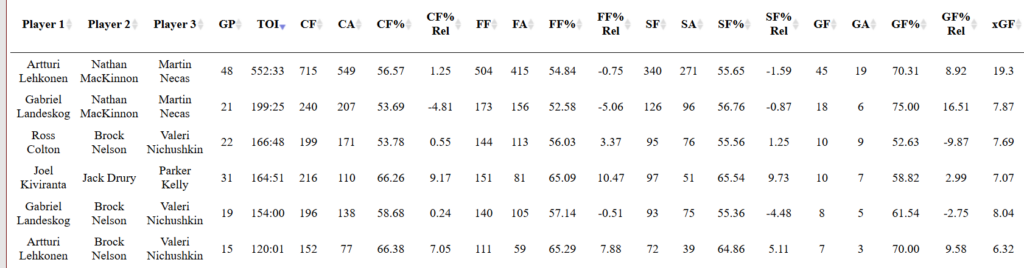
Avs forwards lines sorted by TOI: Landeskog played on first and second line and was generally moved throughout top-9
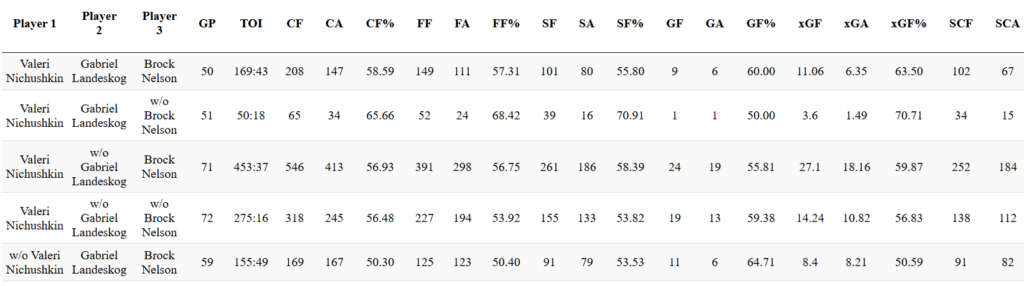
Nelson’s line rendered most effective with both Landeskog and Val Nichushkin

MacKinnon and Necas higher SF% and GF% with Landeskog (though better CF% with Lehkonen), higher xGF relative to TOI with Landeskog

This analytic can get taken out of context a lot, but interestingly: the marginal difference in xGF% of MacKinnon with Landeskog and higher SF% alongside fewer SA proportionate to TOI coincides with the responsibility Landeskog brings alongside meaningful, quality possession
The historic seasons for several of his teammates don’t happen without him.
Next is the eye test, Landeskog’s ability to swing momentum in games by forcing a turnover in the neutral zone to regain possession and give his line quality o-zone time when the game hit a bit of a lull, his role on PP1 taking left-handed draws (68.3%), artfully screening goaltenders from the crease or inside shooting lanes, and generally his leadership… because this player also just won the Mark Messier Leadership Award for his impact as a captain. Is it so hard to reconcile how one of the best leaders in the game might also be very valuable to his team?
Which was my final piece of criteria: the testimony of his teammates and coaches. It’s hard to properly capture how much Landeskog’s impact was discussed among his teammates. It was something they freely and regularly volunteered. When asked about their success, they’d point to Landeskog. Every linemate had the same feedback: “He just does everything right.”
Jared Bednar would even laugh about it to the media, “I tried to tell you all just how important he was…”
When Bednar was asked about the team’s strong record in-season, he’d point to health. The Avs didn’t have the benefit of a healthy Gabriel Landeskog for three years and then they set a new franchise-best regular season record with him back.
Throughout all of my voting, I leveraged my credentialed access and the unique insight I gain from around the League. I had a front row seat to the President’s Trophy winners this season, but I also get to cover the visiting morning skates and evaluate how other teams play the Avs and one another. (Because I do watch a weird amount of hockey.)
Are there other storylines worthy of consideration? Of course: Celebrini’s historic season helped the Sharks to get four points within a wildcard spot (and earned him a spot on my All-Star team), Rasmus Dahlin’s 74 point season earned him Norris votes (and an all All-Star nod from me) and helped Buffalo to break a 14-year playoff drought, Nick Suzuki became the first Canadiens player in over 40 years to hit 100 points.
With so much insight into Landeskog as a leader and his impact on his team, I couldn’t ignore how big of a storyline that was in their path to the President’s Trophy – an impressive feat in its own right.
Additionally, I’ll more quickly address some of the other votes down the ballot:
Selke Trophy:
- Brock Nelson
- Jack Eichel
- Jake Guentzel
- Yanni Gourde
- Nick Schmaltz
Brock Nelson was a revelation on Colorado’s number one ranked penalty kill. After the 2025 deadline, Colorado leaned on Charlie Coyle a lot even though Nelson was also there. With Coyle gone and the sting of an Avs PK that gave up a lot to Dallas in the playoffs, Colorado gave Nelson more of a look on the PK this season. He was third in TOI among Avs’ PK forwards, 12th in d-zone faceoff wins with an overall 50.4% at the dot, 4th fewest GA at 5v5 and top-15 in fewest xGA and SCA (min 1000 min TOI) among centers. While handling top matchups, a lot of his offense came from his defense: a well placed stick-check stripping his opponents of the puck turning into a rush chance for his line. His ability to make the right read to take away a lane emerged as a huge strength and consistency in his game. So much so, he became the guy for d-zone starts late in games – beyond his likelihood to win the draw, he was a safe bet to win pucks back, manage lanes, and breakout.
Calder Trophy:
- Matthew Schaefer
- Ivan Demidov
- Beckett Sennecke
- Jimmy Snuggerud
- Ryan Leonard
Matthew Schaefer is a really special player. This was such a solid rookie class: Sennecke was such a fun player to watch hit the ground running with 23 goals and a 60 point season inside a stacked Anaheim top-six. But, what Schaefer did as an 18-year old rookie managing 24:41 TOI and top matchups nightly is incredible (alongside 23 goals, 36 assists for a 59 point season out the gate). He has a lot of poise for such a young player.
Norris Trophy:
- Zach Werenski
- Cale Makar
- Evan Bouchard
- Lane Hutson
- Quinn Hughes
He finished third in my Norris voting last year, and it was a hard three-spot to give him: Zach Werenski’s consistency back-to-back years earned him the top spot this season. His ascent was impacted by injury before this year, and this feels like the level he’s been capable of. His production is unimpeachable (22 goals 59 assists) finishing second among defenseman behind Evan Bouchard, 3rd in goals, and 2nd in TOI (26:37) behind Quinn Hughes with 91:07 TOI on the PK as well. He’s very trusted and leaned on heavily by Columbus.
All-Star Team
Forwards
Centers: MacKinnon, McDavid, Celebrini
Celebrini is a powerhouse. Though these Awards are based on regular season results (of which, his are highly impressive), his Team Canada spot is a reflection of the respect he commands from his peers in how he has taken ownership of the centerman position with maturity and responsibility while being highly effective offensively. He’s such a strong competitor. He’s one of the best centers in the game right now, and he’ll only further solidify his stamp on the League from here.
Defense
- Cale Makar
- Zach Werenski
- Miro Heiskanen
- Lane Hutson
- Rasmus Dahlin
- Evan Bouchard
Miro Heiskanen is so complete year after year, I have a deep appreciation for his two-way game. Of this crop of players, he penalty killed the most (though Makar is also up there after missing some games and Bouchard took on more PK responsibility this season) while staying a 63 point player. He’s really steady in what he provides defensively while also quarterbacking Dallas’ dangerous PP.
Goaltending: Vasilevskiy, Wedgewood, Blackwood.
I didn’t think the William M. Jennings Trophy winners would be out of place here. Wedgewood finished fifth in Vezina voting and I laid out some more of his stats earlier. The pair combined for the the fewest goals against, and Blackwood was on the shortlist for Team Canada (keeping in mind the politics behind those decisions as well) – two shutouts (three total on the year) and 0.925 SV% 5-0-1 in his first month after missing time to injury, 2nd best GAA (all situations, min. 1000 minutes TOI) through the end of February, and top-10 GAA (all situations, min. 1000 minutes TOI) all said and done. In hindsight, I’m willing to relent on my third place spot and give more love to Logan Thompson, Ukko-Pekka Luukkonen, Filip Gustavsson, or Ilya Sorokin in place of Blackwood whose numbers were impacted by some funky outings near the end of the season. However, I maintain that the pair is defensible given the success of the goaltending tandem together in the regular season.
Lady Byng: Honestly this is a weird award, a lot of writers just pick a player with the lowest penalty minutes. Though we can speak to their affability with the media, and generally what we observe of their on-ice conduct, we are not the greatest source on their sportsmanship. So “sportsmanship and gentlemanly conduct combined with a high standard of playing ability” – it’s a very open category with a lot of variance every year… like, so much variance it’s hard to reach a consensus unless there is collaboration. I picked two top pair defensemen (Devon Toews, Makar) who have earned nominations in this category every year for years – and two players who are beloved by teammates on prior teams (based on interviews I’ve done with former teammates), commanding respect around the League (Brent Burns and Wedgewood). And Mark Scheifele who is a great representation of the sport (and not just because he doesn’t curse).
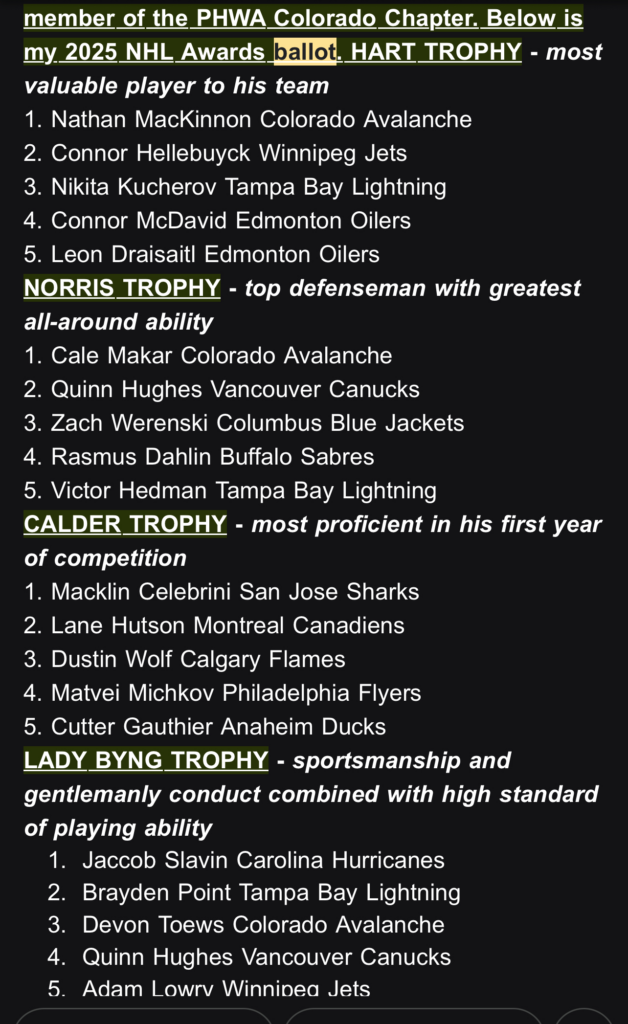
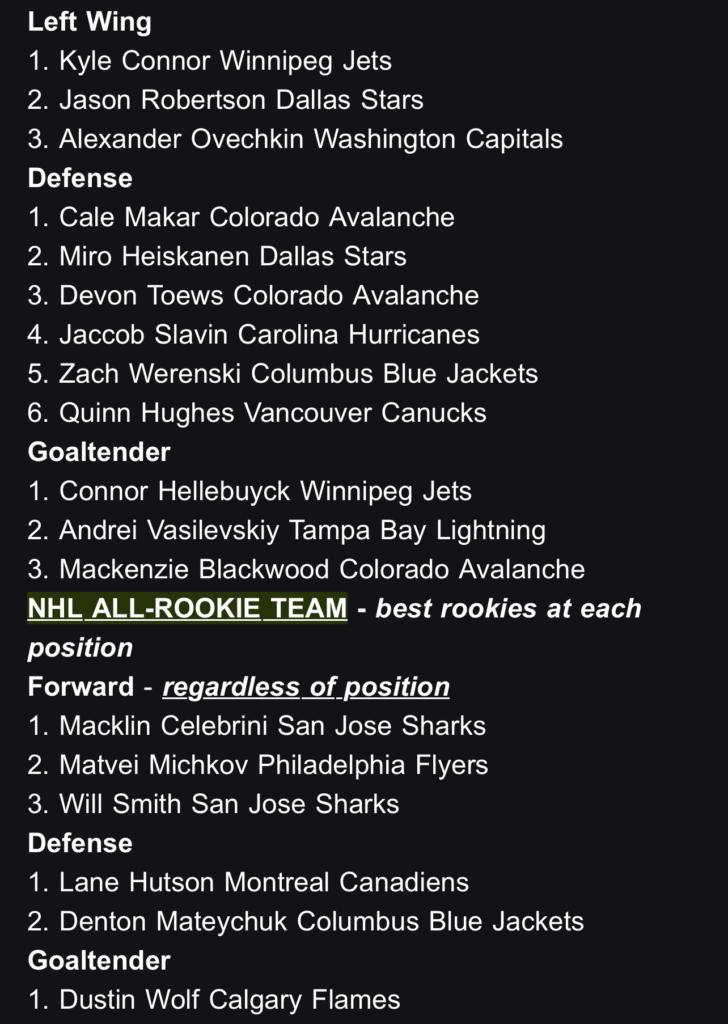
Finally, I’ll include last year’s ballot to give you more insight into my voting record/habits.
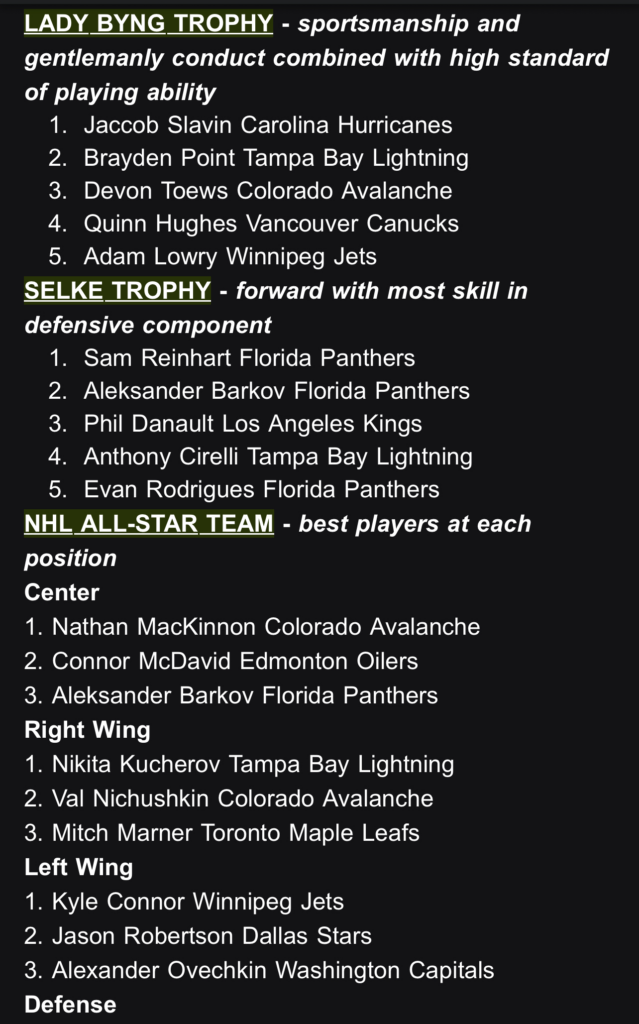
I’ll be entering my sixth season and I take a lot of pride in the work that I do (spanning multiple leagues including AHL, NCAA, and occasionally CHL for prospect coverage).
I appreciate any of you who are combing through this in good faith. Voting is a privilege and it’s not one I take for granted.